
Nyongesa Sande
No Result
View All Result
  • News
    • World
    • Africa
  • Politics
  • Business
  • Tech
  • AI
  • Telecom
  • Sports
  • Opinion
  • Lifestyle
  • Live
  • World Cup 2026
    • World Cup 2026 Standings
    • World Cup 2026
Nyongesa Sande
  • About Us
    • Nyosake Designers
      • Nyosake Webmasters
      • Nyosake Investment
  • Contact Us
    • Newsroom Contact
  • Ownership Disclosure
  • Advertise
No Result
View All Result
Nyongesa Sande
No Result
View All Result
  • News
  • Politics
  • Business
  • Tech
  • AI
  • Telecom
  • Sports
  • Opinion
  • Lifestyle
  • Live
  • World Cup 2026
ADVERTISEMENT

Home » Appendicitis

Appendicitis

Causes, Symptoms, and Treatment

NyongesaSande News Desk by NyongesaSande News Desk
2 years ago
in Health
Reading Time: 5 mins read
A A
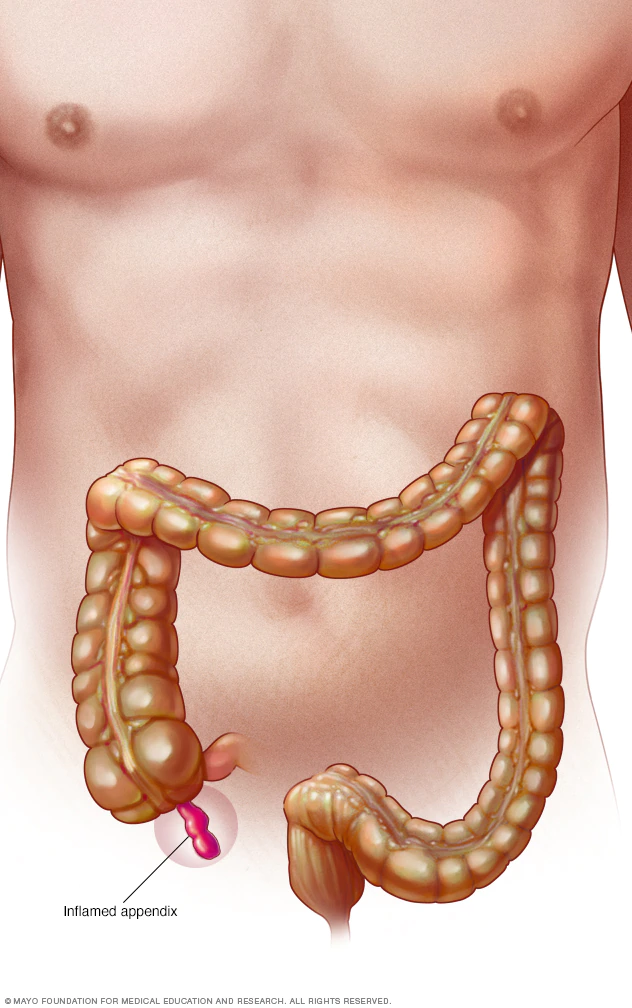
Appendicitis

Mayo Clinic

Appendicitis is the inflammation of the appendix, a small finger-shaped pouch attached to the colon in the lower right abdomen. While the exact purpose of the appendix is not fully understood, appendicitis is a common and potentially serious medical condition requiring prompt treatment, often through surgery.

  • Symptoms of Appendicitis
  • When to See a Doctor
  • Causes of Appendicitis
  • Risk Factors
  • Complications
  • Diagnosis
  • Treatment Options
  • Prevention

Symptoms of Appendicitis

The symptoms of appendicitis can vary but commonly include:

  • Pain:
    • Sudden pain starting near the belly button that moves to the lower right abdomen.
    • Pain worsens with coughing, walking, or sudden movements.
  • Digestive issues:
    • Nausea and vomiting.
    • Loss of appetite.
    • Constipation or diarrhea.
    • Bloating or gas.
  • Fever:
    • Low-grade fever that may increase as the condition worsens.

In some cases, the location of pain may differ, such as during pregnancy when the appendix is pushed higher in the abdomen.

ADVERTISEMENT

When to See a Doctor

Seek immediate medical attention if you or your child experiences severe abdominal pain, especially if it is accompanied by symptoms like fever, nausea, or vomiting. Prompt evaluation and treatment are essential to avoid complications.


Causes of Appendicitis

Appendicitis often occurs when the appendix becomes blocked, leading to inflammation and infection. Common causes include:

ADVERTISEMENT
  • Blockage in the appendix lumen:
    • Stool, foreign objects, or enlarged lymph nodes can obstruct the appendix.
  • Infection:
    • Bacterial infections cause rapid multiplication of bacteria, leading to swelling and pus formation.

If untreated, the appendix may burst, spreading infection to other parts of the abdomen.


Risk Factors

The likelihood of developing appendicitis increases with certain factors:

  • Age: Most common between 10 and 30 years.
  • Sex: Slightly more common in men.

Complications

Appendicitis can lead to severe complications, such as:

ADVERTISEMENT
  1. Burst Appendix (Ruptured Appendix):
    • A ruptured appendix spreads infection throughout the abdomen, causing peritonitis.
    • This life-threatening condition requires emergency surgery.
  2. Abdominal Abscess:
    • An abscess is a pocket of pus that forms in the abdomen if the appendix bursts.
    • Treatment involves draining the abscess using a tube and antibiotics to clear the infection, often followed by surgery to remove the appendix.

Diagnosis

Diagnosis typically involves:

  • Physical examination: Assessing pain and tenderness in the lower right abdomen.
  • Imaging tests: Ultrasound or CT scans to confirm inflammation.
  • Blood tests: Detecting infection through elevated white blood cell counts.

Treatment Options

The treatment for appendicitis depends on the severity and includes:

  1. Antibiotics:
    • Used to treat mild cases or as a preparatory step before surgery.
  2. Appendectomy:
    • Surgical removal of the appendix is the standard treatment.
    • Procedures include:
      • Laparoscopic surgery: Minimally invasive and involves smaller incisions.
      • Open surgery: Performed for complex cases, such as ruptured appendices.
  3. Drainage of Abscess:
    • If an abscess forms, it is often drained before the appendix is removed.

Prevention

There is no guaranteed way to prevent appendicitis. However, maintaining a healthy diet rich in fiber (fruits, vegetables, and whole grains) may lower the risk of blockage in the appendix.


Appendicitis is a treatable condition, but early diagnosis and intervention are crucial to preventing complications. If you experience symptoms, consult a healthcare professional promptly for evaluation and care.

ShareTweetSendShareScanSharePinShareShare
Google Add as a Preferred Source on Google
Previous Post

Aplastic Anemia

Next Post

Acute Respiratory Distress Syndrome (ARDS)

NyongesaSande News Desk

NyongesaSande News Desk

Nyongesa Sande offers diverse content across news, technology, entertainment, and more, aiming to provide readers with a wide range of informative and engaging articles. NYONGESA SANDE's dedicated team provides our audience not only with the highly relevant news but also with outstanding interactive experience.

Related Posts

Sarah Ng’ang’a’s Journey Building Juja Modern Hospital
Hospitals

Sarah Ng’ang’a’s Journey Building Juja Modern Hospital

4 weeks ago
Accredited Rehabilitation Centres in Kenya: Full List, Contacts and Locations
Health

Accredited Rehabilitation Centres in Kenya: Full List, Contacts and Locations

4 weeks ago
Luhya Traditional Herbs and Indigenous Healing Practices in Western Kenya
Health

Luhya Traditional Herbs and Indigenous Healing Practices in Western Kenya

1 month ago
Enfield Royal Clinic Dubai Company Profile
Hospitals

Enfield Royal Clinic Dubai Company Profile

1 month ago
Hantavirus
Health

Hantavirus

2 months ago
Orthohantavirus
Health

Orthohantavirus

2 months ago
Load More
Next Post
The bronchioles are some of the smallest airways in the lungs. Inhaled air passes through tiny ducts from the bronchioles into elastic air sacs (alveoli). The alveoli are surrounded by the alveolar-capillary membrane, which typically prevents liquid in the capillaries from entering the air sacs.

Acute Respiratory Distress Syndrome (ARDS)

Arteriosclerosis and Atherosclerosis

Arteriosclerosis and Atherosclerosis

ADVERTISEMENT

Who We Are

Nyongesa Sande

NyongesaSande.com is a digital news and media platform covering breaking news, business, technology, AI, politics, sports, world affairs and African innovation.

News Sections

  • News
    • World
    • Africa
  • Politics
  • Business
  • Tech
  • AI
  • Telecom
  • Sports
  • Opinion
  • Lifestyle
  • Live
  • World Cup 2026
    • World Cup 2026 Standings
    • World Cup 2026

Editorial Standards

  • Editorial Policy
  • Fact Checking Policy
  • Corrections Policy
  • Ethics Policy
  • AI Usage Policy
  • News Tips
  • Submit Press Release

Legal

  • Privacy Policy
  • Terms of Use
  • Cookie Policy
  • Disclaimer
  • Risk Disclaimer
  • DMCA
  • Ad Choices

Our Company

  • About Us
    • Nyosake Designers
      • Nyosake Webmasters
      • Nyosake Investment
  • Contact Us
    • Newsroom Contact
  • Ownership Disclosure
  • Advertise
  • Privacy Policy
  • Terms of Use
  • Cookie Policy
  • Disclaimer
  • Risk Disclaimer
  • DMCA
  • Ad Choices

NyongesaSande.com is an independent digital news and media platform covering Africa, business, technology, AI, politics and global developments.

© 2026 NyongesaSande.com. All rights reserved.

No Result
View All Result
  • News
    • World
    • Africa
  • Politics
  • Business
  • Tech
  • AI
  • Telecom
  • Sports
  • Opinion
  • Lifestyle
  • Live
  • World Cup 2026
    • World Cup 2026 Standings
    • World Cup 2026

NyongesaSande.com is an independent digital news and media platform covering Africa, business, technology, AI, politics and global developments.

© 2026 NyongesaSande.com. All rights reserved.