


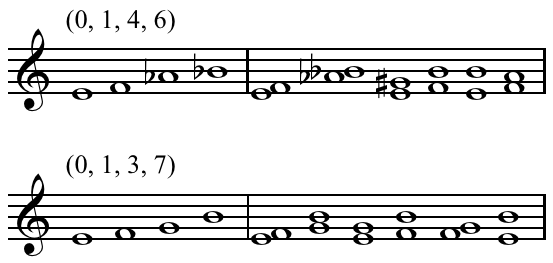
An all-interval tetrachord is a set of four pitch classes in music theory that contains all six interval classes. This means it includes every possible interval between pairs of notes within the tetrachord. The all-interval tetrachord is a fascinating and versatile concept in set theory and has been used extensively in 20th-century classical music. The term “tetrachord” refers to a collection of four notes, and when we say “all-interval,” we mean that this collection spans all six of the possible interval classes between its notes.
Structure and Types of All-Interval Tetrachords
There are only two unique all-interval tetrachords, considering inversion as a factor. These tetrachords are:
- [0, 1, 4, 6] (4-Z15)
- [0, 1, 3, 7] (4-Z29)
These are both considered the “prime form” of the all-interval tetrachord, and they can also be represented in inverted forms:
- Inversion of [0,1,4,6]: [0, 2, 5, 6] (4-Z15b)
- Inversion of [0,1,3,7]: [0, 4, 6, 7] (4-Z29b)
The interval vector for all all-interval tetrachords is consistently [1, 1, 1, 1, 1, 1], signifying that each of the six interval classes is used exactly once between the four notes of the tetrachord.
Interval Classes and Their Diatonic Counterparts
Each all-interval tetrachord spans a variety of interval classes, which represent different types of distances between the notes. The interval classes for the two prime forms of the tetrachord can be represented in a table for clarity:
For [0, 1, 4, 6] (4-Z15)
| Interval Class (ic) | Notes | Diatonic Counterparts |
|---|---|---|
| 1 | E to F | Minor 2nd and Major 7th |
| 2 | A♭ to B♭ | Major 2nd and Minor 7th |
| 3 | F to A♭ | Minor 3rd and Major 6th |
| 4 | E to G♯ | Major 3rd and Minor 6th |
| 5 | F to B♭ | Perfect 4th and Perfect 5th |
| 6 | E to B♭ | Augmented 4th and Diminished 5th |
For [0, 1, 3, 7] (4-Z29)
| Interval Class (ic) | Notes | Diatonic Counterparts |
|---|---|---|
| 1 | E to F | Minor 2nd and Major 7th |
| 2 | F to G | Major 2nd and Minor 7th |
| 3 | E to G | Minor 3rd and Major 6th |
| 4 | G to B | Major 3rd and Minor 6th |
| 5 | E to B | Perfect 4th and Perfect 5th |
| 6 | F to B | Augmented 4th and Diminished 5th |
These intervals provide a comprehensive span of relationships between the notes, showcasing the versatility and complexity of the all-interval tetrachord.
Use in Modern Music
The all-interval tetrachord has been used extensively in 20th-century music, particularly by composers who explored set theory and serialism. Its unique properties make it an excellent tool for creating harmonic and melodic structures that are rich in intervallic relationships. Some notable composers who have used the all-interval tetrachord include:
- Frank Bridge
- Elliott Carter (particularly in his First String Quartet)
- George Perle
These composers used the all-interval tetrachord to craft compositions that explore the full range of harmonic possibilities, often emphasizing dissonance and complex intervallic relationships.


