


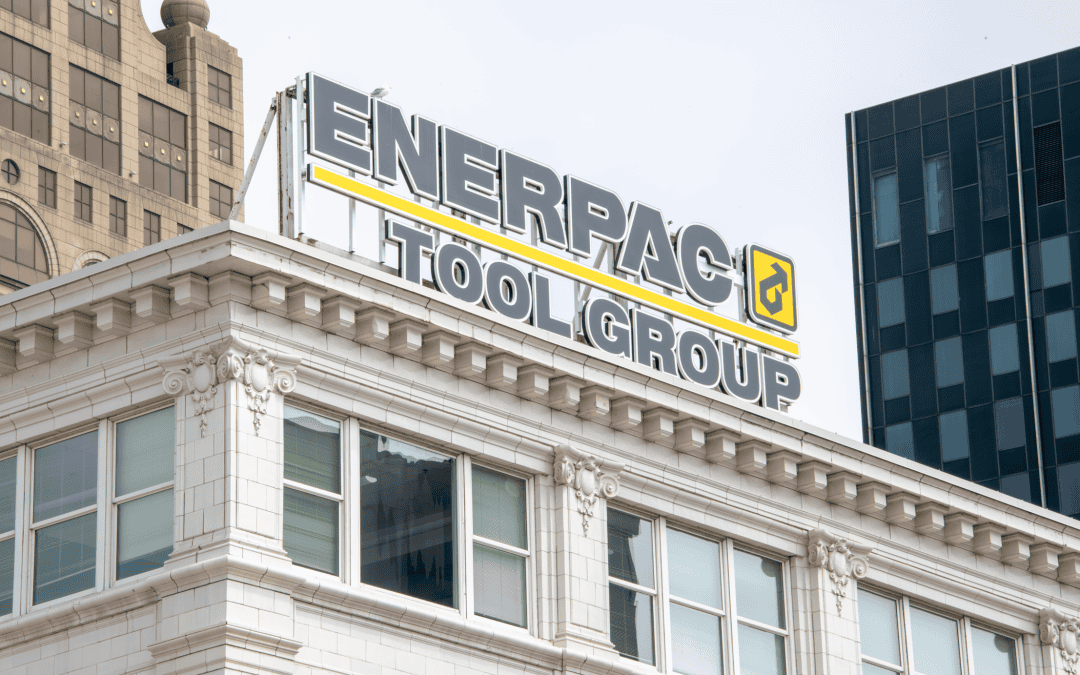
Actuant acquisitions show how the company now known as Enerpac Tool Group built a broad industrial portfolio across hydraulic tools, controlled bolting, portable machining, electrical systems, vehicle instrumentation, power transmission, heavy lifting, marine services, and energy-sector maintenance.
The company has a long corporate history. Enerpac Tool Group Corp., formerly Actuant Corporation, traces its roots to 1910. It was later known for industrial products, high-force tools, and engineered systems. The company’s common stock trades on the New York Stock Exchange under the symbol EPAC.
The uploaded acquisition data states that Actuant made 24 acquisitions between 1996 and 2018. These deals had a total disclosed value of $1.9 billion and an average disclosed deal size of $79.4 million. The most frequent acquisition sectors were manufacturing, machinery manufacturing, electronics, energy, and construction.
The visible dataset lists Equalizer International as Actuant’s most recent acquisition, announced in May 2018 for $5.8 million. Other notable listed deals include Mirage Machines, FourQuest MENAC, Precision-Hayes International, Viking SeaTech, CrossControl, Weasler Engineering, Mastervolt, Cortland Company, Superior Plant Services, Hydratight, D.L. Ricci, Precision Sure-Lock, Maxima Technologies, and Key Components.
The broader company history also includes the 2019 name change from Actuant Corporation to Enerpac Tool Group. After that change, the company began trading under the ticker EPAC. Enerpac later opened a new global headquarters in downtown Milwaukee in 2025.
This article explains the Actuant acquisitions timeline, the biggest deals, the company’s transformation into Enerpac Tool Group, and the strategic lessons behind its industrial M&A history.
What Is Actuant?
Actuant Corporation was a diversified industrial company that operated globally. It became known for high-force industrial tools, hydraulic products, mechanical systems, engineered components, and services for industrial, energy, infrastructure, construction, marine, agricultural, and vehicle markets.
In 2019, Actuant changed its name to Enerpac Tool Group. The change reflected a strategic shift toward becoming a more focused industrial tools and services company. Enerpac Tool Group trades on the NYSE under the ticker EPAC.
Enerpac is best known for high-pressure hydraulic tools and heavy-lifting equipment. Its products are used in infrastructure, manufacturing, maintenance, energy, mining, construction, and industrial service applications.
The company’s acquisition history shows how Actuant built its capabilities before becoming a more focused Enerpac-branded business.
Why Actuant Acquisitions Matter
Actuant acquisitions matter because they explain how the company moved from a diversified industrial group toward a specialized industrial tools platform.
Many of the acquired businesses were not consumer-facing brands. They were industrial companies that made or serviced important tools, components, and systems used in demanding work environments.
These acquisitions helped Actuant:
- Expand its high-force tool portfolio.
- Build controlled bolting and joint integrity capabilities.
- Add portable machining technologies.
- Strengthen energy-sector services.
- Expand into marine and offshore markets.
- Add electronics and vehicle instrumentation.
- Build construction-related tensioning and anchoring capabilities.
- Add power transmission and electro-technical systems.
- Expand geographically.
The strategy was practical. Industrial customers often need reliable tools, maintenance systems, and engineered equipment that can perform under heavy load, high pressure, or complex field conditions.
Actuant used acquisitions to add those specialized capabilities.
Full List of Visible Actuant Acquisitions
The uploaded file states that Actuant made 24 acquisitions from 1996 to 2018. The visible file section shows 20 of those 24 deals. The table below summarizes the visible acquisitions.
| Acquiree | Announced Date | Price | Main Sector | Strategic Relevance |
|---|---|---|---|---|
| Equalizer International Ltd | May 15, 2018 | $5.8M | Industrial engineering | Added flange maintenance tools |
| Mirage Machines | Aug. 16, 2017 | $16.0M | Portable machining | Added on-site machine tools |
| FourQuest MENAC | Mar. 30, 2016 | $60.0M | Energy services | Added pipeline and process services |
| Precision-Hayes International | May 23, 2014 | $31.0M | Construction / machinery | Added prestress anchorage and stressing tools |
| Viking SeaTech | Aug. 2, 2013 | $225.0M | Marine energy services | Added offshore and marine services |
| CrossControl | Jul. 20, 2012 | $40.0M | Electronics / industrial vehicles | Added human-machine interface and control systems |
| Weasler Engineering | Apr. 20, 2011 | $155.0M | Power transmission | Added mechanical power transmission products |
| Mastervolt | Nov. 30, 2010 | $150.0M | Electro-technical systems | Added power systems for marine and mobile applications |
| Cortland Company | Sep. 17, 2008 | $230.0M | Cables and synthetic rope | Added electro-mechanical cables and engineered rope |
| Superior Plant Services | Mar. 3, 2008 | $57.0M | Maintenance services | Added oil, gas, and nuclear maintenance services |
| T.T. Fijnmechanica B.V. | Apr. 16, 2007 | $20.0M | Heavy lifting / infrastructure | Added bridge, infrastructure, and heavy-lifting systems |
| Maxima Technologies | Dec. 22, 2006 | $91.0M | Electronics / instrumentation | Added vehicle instrumentation |
| Actown-Electrocoil | Aug. 17, 2006 | $24.0M | Industrial manufacturing | Added transformers, inductors, and coils |
| Precision Sure-Lock | Apr. 28, 2006 | $43.0M | Machinery manufacturing | Added anchoring systems and wedges |
| D.L. Ricci Corp. | Apr. 21, 2006 | $50.0M | Portable machining | Added portable machining equipment |
| B.E.P. Marine | Dec. 16, 2005 | $8.0M | Marine electrical systems | Added marine electrical solutions |
| Hydratight Ltd. | May 17, 2005 | $93.0M | Machinery manufacturing | Added mechanical products and joint integrity capability |
| Hedley Purvis Holdings | Jan. 20, 2005 | $28.0M | Torque tools | Added torque wrench technology |
| Sperry Instruments | Dec. 1, 2004 | $12.5M | Electronics / testing | Added meters and test equipment |
| Key Components | Nov. 18, 2004 | $315.0M | Custom-engineered components | Added engineered componentry |
The visible list shows a clear industrial pattern. Actuant bought companies that made tools, systems, components, electronics, machinery, and services for customers operating in difficult environments.
Actuant Acquisitions Timeline
The Actuant acquisitions timeline shows how the company expanded across several industrial niches before becoming Enerpac Tool Group.
2004: Key Components and Sperry Instruments
The visible acquisition data begins with two deals in 2004.
Actuant acquired Key Components in November 2004 for $315.0 million. Key Components manufactured custom-engineered essential componentry for a wide range of end-use products.
This was the largest visible Actuant acquisition in the dataset. It gave Actuant more scale in engineered components and strengthened its position in specialized manufacturing.
In December 2004, Actuant acquired Sperry Instruments for $12.5 million. Sperry Instruments designed, tested, assembled, packaged, and marketed meters to major companies.
This deal added electronics and test-and-measurement capability. It also fit Actuant’s broader interest in practical industrial and electrical products.
2005: Hedley Purvis, Hydratight, and B.E.P. Marine
The year 2005 was important because Actuant moved deeper into joint integrity, torque tools, and marine electrical systems.
In January 2005, Actuant acquired Hedley Purvis Holdings for $28.0 million. Hedley Purvis designed and manufactured torque wrenches. Torque tools are essential in industrial maintenance because bolts and joints must be tightened to precise specifications.
In May 2005, Actuant acquired Hydratight Ltd. for $93.0 million. Hydratight designed and manufactured mechanical products. The acquisition helped Actuant build its joint integrity platform.
Joint integrity matters in industries such as oil and gas, power generation, petrochemicals, and heavy manufacturing. If a bolted joint fails, the result can be downtime, leaks, safety incidents, and expensive repairs.
In December 2005, Actuant acquired B.E.P. Marine for $8.0 million. B.E.P. Marine manufactured and distributed electrical solutions for marine applications.
These acquisitions show that Actuant was building both tool capability and sector exposure.
2006: Portable Machining, Anchoring Systems, Coils, and Instrumentation
The year 2006 was highly active in the visible Actuant acquisitions timeline.
In April 2006, Actuant acquired D.L. Ricci Corp. for $50.0 million. D.L. Ricci manufactured and designed portable machining equipment. Portable machining allows technicians to perform machining work directly on-site rather than moving large equipment to a workshop.
Also in April 2006, Actuant acquired Precision Sure-Lock for $43.0 million. Precision Sure-Lock manufactured and supplied anchor systems and wedges. This strengthened Actuant in construction-related tensioning and anchoring products.
In August 2006, Actuant acquired Actown-Electrocoil for $24.0 million. The company designed and manufactured transformers, inductors, and coils.
In December 2006, Actuant acquired Maxima Technologies for $91.0 million. Maxima Technologies specialized in custom-engineered and standard vehicle instrumentation.
These deals expanded Actuant across machinery, construction, electronics, industrial manufacturing, and vehicle markets.
2007: T.T. Fijnmechanica B.V.
In April 2007, Actuant acquired T.T. Fijnmechanica B.V. for $20.0 million.
The company supplied products and systems for bridge building, infrastructure, and heavy-lifting markets.
This deal fit well with Actuant’s industrial tool identity. Heavy lifting and infrastructure work require specialized equipment that can operate safely under high loads.
The acquisition strengthened Actuant’s position in infrastructure-related applications.
2008: Superior Plant Services and Cortland Company
In 2008, Actuant acquired Superior Plant Services and Cortland Company.
Superior Plant Services was acquired in March 2008 for $57.0 million. The company provided specialized maintenance services to oil and gas and nuclear power industries.
This deal expanded Actuant’s energy-sector services. Maintenance services are important because energy facilities require reliable uptime, safety, and skilled technical support.
In September 2008, Actuant acquired Cortland Company for $230.0 million. Cortland manufactured electro-mechanical cables, umbilicals, and engineered synthetic rope.
Cortland was one of the largest visible acquisitions in the dataset. It gave Actuant more exposure to marine, energy, offshore, and engineered rope applications.
2010: Mastervolt
In November 2010, Actuant acquired Mastervolt for $150.0 million.
Mastervolt manufactured and distributed electro-technical systems. Its products supported power systems, especially in marine, mobile, and off-grid applications.
This acquisition expanded Actuant’s electrical and power-management capabilities.
Mastervolt also helped Actuant diversify beyond mechanical tools into electrical systems that support mobility and industrial applications.
2011: Weasler Engineering
In April 2011, Actuant acquired Weasler Engineering for $155.0 million.
Weasler Engineering manufactured and distributed mechanical power transmission products.
Power transmission products are used in agricultural, industrial, and mobile equipment. They help transfer mechanical power safely and reliably from one part of a machine to another.
This acquisition strengthened Actuant’s engineered components and industrial equipment portfolio.
2012: CrossControl
In July 2012, Actuant acquired CrossControl for $40.0 million.
CrossControl supported manufacturers of industrial vehicles with control systems that put humans in control. The company’s tags included computer, electronics, and information technology.
This deal added human-machine interface and vehicle control capability.
Industrial vehicles need rugged displays, controls, and electronics that can work in harsh conditions. CrossControl helped Actuant serve those markets.
2013: Viking SeaTech
In August 2013, Actuant acquired Viking SeaTech for $225.0 million.
Viking SeaTech provided marine services to the energy industry. This was one of the largest visible Actuant acquisitions.
The deal expanded Actuant’s offshore and energy-sector service capability. Marine services are important in oil and gas, offshore construction, vessel operations, and energy infrastructure.
However, Viking SeaTech was later sold in 2017, according to the company history you provided. That sale reflected Actuant’s move away from some non-core activities as it became more focused.
2014: Precision-Hayes International
In May 2014, Actuant acquired Precision-Hayes International for $31.0 million.
Precision-Hayes manufactured prestress anchorages, barrier cable products, and stressing tools for post-tensioning and pre-tensioning markets.
This acquisition strengthened Actuant’s construction and infrastructure tooling portfolio.
Post-tensioning and pre-tensioning are important in concrete construction. They help improve strength, reduce cracking, and support large structures such as bridges, parking decks, and buildings.
2016: FourQuest MENAC
In March 2016, Actuant acquired FourQuest MENAC for $60.0 million.
FourQuest MENAC provided pipeline and process services. This deal strengthened Actuant’s energy-sector service platform.
Pipeline and process services are important in oil, gas, petrochemicals, refining, and industrial facilities. These services support commissioning, maintenance, shutdowns, and operational reliability.
The acquisition fit Actuant’s joint integrity and industrial service strategy.
2017: Mirage Machines
In August 2017, Actuant acquired Mirage Machines for $16.0 million.
Mirage Machines manufactured and designed portable on-site machine tools.
This acquisition strengthened Actuant’s portable machining offering. It also complemented earlier acquisitions such as D.L. Ricci.
Portable machining is valuable because it reduces downtime. Instead of moving large industrial equipment, technicians can machine, cut, drill, or repair parts at the job site.
2018: Equalizer International
In May 2018, Actuant acquired Equalizer International for $5.8 million.
Equalizer International designed and supplied flange maintenance tools. The acquisition was Actuant’s most recent listed deal in the uploaded dataset.
Flange maintenance tools are used in bolted joint work, especially in industries where pipework, pressure systems, and mechanical connections must be opened, aligned, maintained, and closed safely.
This acquisition fit Actuant’s joint integrity and maintenance-tool platform.
Company History and Transformation Into Enerpac Tool Group
Actuant’s acquisition story makes more sense when viewed alongside its corporate history.
Early Roots and Applied Power
The company traces its roots to 1910. Enerpac itself was founded in 1958 under the Applied Power name.
Applied Power went public in 1987 and began trading on NASDAQ. The following year, it acquired Gardner Bender from the Gardner family. In 1989, Applied Power acquired Barry Wright Corporation.
These early moves helped the company expand beyond its original base and build a diversified industrial group.
Spin-Off and Focused Industrial Growth
In 2000, the company announced the spin-off of its electronics business segment, doing business as AWP, Ltd.
After that period, Actuant continued to build an industrial portfolio through acquisitions. Many of the visible deals from 2004 onward strengthened manufacturing, machinery, electronics, energy, construction, and industrial tools.
The Joint Integrity Platform
In 2005, Actuant acquired Hedley Purvis and Hydratight. These deals helped initiate the company’s joint integrity platform.
This platform later became an important part of the company’s industrial tools and services identity. Joint integrity covers tools and services used to tighten, loosen, align, separate, and maintain bolted joints safely.
The Enerpac Tool Group Name Change
In 2019, Actuant changed its name to Enerpac Tool Group. The company also began trading under the ticker EPAC.
The name change reflected a strategic reset. Enerpac was one of the company’s most recognizable brands, and the new name emphasized industrial tools and services.
In 2019, Enerpac also sold its engineered components and systems segment to One Rock Capital. That business was renamed CentroMotion. This move helped Enerpac become more focused on industrial tools.
Milwaukee Headquarters Move
Enerpac Tool Group announced plans in 2024 to move its headquarters to downtown Milwaukee. The company expected to move in late 2024 or early 2025 after renovations.
In May 2025, Enerpac Tool Group held a grand opening event for its new global headquarters in Milwaukee.
This move marked another step in the company’s modern identity as a focused industrial tools business.
Biggest Visible Actuant Acquisitions by Deal Value
The largest visible Actuant acquisitions show where the company made its biggest strategic commitments.
| Rank | Acquisition | Year | Deal Value |
| 1 | Key Components | 2004 | $315.0M |
| 2 | Cortland Company | 2008 | $230.0M |
| 3 | Viking SeaTech | 2013 | $225.0M |
| 4 | Weasler Engineering | 2011 | $155.0M |
| 5 | Mastervolt | 2010 | $150.0M |
| 6 | Hydratight Ltd. | 2005 | $93.0M |
| 7 | Maxima Technologies | 2006 | $91.0M |
| 8 | FourQuest MENAC | 2016 | $60.0M |
| 9 | Superior Plant Services | 2008 | $57.0M |
| 10 | D.L. Ricci Corp. | 2006 | $50.0M |
These large deals show Actuant’s focus on engineered components, marine and energy services, power transmission, electro-technical systems, mechanical tools, vehicle electronics, and industrial maintenance.
Most Common Actuant Acquisition Sectors
The uploaded dataset identifies manufacturing, machinery manufacturing, electronics, energy, and construction as the most common sectors.
| Sector | Number of Deals | Strategic Importance |
| Manufacturing | 15 | Strengthened industrial products, components, and tools |
| Machinery Manufacturing | 8 | Added machining, torque, bolting, and heavy-lifting capabilities |
| Electronics | 6 | Added instrumentation, control systems, meters, and electrical products |
| Energy | 2 | Expanded oil, gas, pipeline, and marine energy services |
| Construction | 2 | Added anchoring, stressing, and infrastructure-related tools |
This sector mix shows that Actuant acquisitions were concentrated in practical industrial markets rather than consumer categories.
Strategic Lessons From Actuant Acquisitions
The Actuant acquisitions timeline offers several lessons about industrial M&A strategy.
Actuant Built Around Specialized Industrial Niches
Actuant did not only buy broad manufacturing companies. It bought specialized businesses with specific industrial functions.
Examples include flange maintenance, portable machining, torque tools, anchor systems, heavy-lifting systems, vehicle controls, and electro-mechanical cables.
Specialized industrial niches can be attractive because customers often care about reliability, safety, service, and technical performance.
Joint Integrity Became a Core Theme
Hedley Purvis, Hydratight, FourQuest MENAC, Mirage Machines, and Equalizer International all connect to maintenance, bolting, machining, and joint integrity.
This theme fits Enerpac’s modern identity. Industrial customers need safe and reliable tools for bolted connections, especially in energy, infrastructure, and heavy industry.
Energy and Marine Services Added Growth but Also Cyclicality
Viking SeaTech, Superior Plant Services, FourQuest MENAC, Cortland, and B.E.P. Marine gave Actuant exposure to energy and marine markets.
These markets can generate strong demand when oil, gas, offshore, and industrial spending are healthy. However, they can also be cyclical. When energy prices fall or offshore projects slow, demand may weaken.
The later sale of Viking SeaTech shows how companies may reverse course when a business no longer fits the strategy.
Electronics Expanded the Portfolio
Sperry Instruments, B.E.P. Marine, Actown-Electrocoil, Maxima Technologies, CrossControl, and Mastervolt all strengthened Actuant’s electronics or electrical systems exposure.
These acquisitions helped the company serve vehicles, marine systems, industrial customers, and test-and-measurement markets.
Focus Became More Important Over Time
The 2019 name change to Enerpac Tool Group and sale of the engineered components and systems segment showed a move toward focus.
Many industrial conglomerates eventually simplify their portfolios. Focus can help management allocate capital, improve margins, clarify the brand, and communicate strategy to investors.
How Actuant Acquisitions Fit Enerpac Tool Group Today
Enerpac Tool Group today is more focused than Actuant was during its broader diversification years.
Enerpac is centered on industrial tools and services. The company serves customers that need high-force tools, hydraulic systems, controlled bolting products, portable machining, heavy lifting, and maintenance solutions.
The acquisition history still matters because many of Actuant’s earlier deals helped build the capabilities that support Enerpac’s current market identity.
For example:
- Hydratight and Hedley Purvis supported joint integrity.
- D.L. Ricci and Mirage Machines supported portable machining.
- Equalizer International supported flange maintenance.
- Precision-Hayes supported stressing and anchoring tools.
- T.T. Fijnmechanica supported heavy-lifting systems.
- Mastervolt and CrossControl showed the company’s former broader engineered-systems exposure.
The modern Enerpac strategy is more disciplined. In fiscal 2025, Enerpac reported net sales from continuing operations of $617 million and said this represented record revenue since the 2019 relaunch of Enerpac Tool Group.
Competitive Impact of Actuant Acquisitions
Actuant acquisitions helped the company compete in industrial tools and engineered systems.
The deals added technology, product categories, geographic reach, and customer relationships. They also helped the company serve industries where downtime is expensive and equipment reliability is essential.
The main competitive benefits included:
- Wider product range.
- Stronger industrial tool brands.
- More technical expertise.
- Better access to energy and infrastructure customers.
- Deeper maintenance and service capabilities.
- Expansion into portable machining and controlled bolting.
- Broader international footprint.
However, acquisitions also created complexity. Actuant owned businesses across many industrial categories. That made strategic focus more difficult.
The shift to Enerpac Tool Group helped address this by emphasizing the company’s strongest industrial tools identity.
Advantages of the Actuant Acquisition Strategy
Actuant acquisitions created several advantages.
Broader Industrial Product Range
The company added tools, machinery, components, electronics, cables, ropes, controls, instrumentation, and maintenance services.
Stronger Joint Integrity Platform
Hydratight, Hedley Purvis, FourQuest MENAC, Mirage Machines, and Equalizer International strengthened the company’s bolting, machining, and flange-maintenance capabilities.
Deeper Energy and Infrastructure Exposure
Several acquisitions served oil and gas, nuclear power, marine, bridge building, heavy lifting, and industrial maintenance markets.
Technical Differentiation
Many acquired businesses produced specialized products where technical reliability matters.
Geographic Expansion
Acquisitions helped the company expand into Europe, marine markets, energy hubs, and international industrial sectors.
Better Service Offering
Actuant bought not only product companies but also service providers. This helped it support customers in the field.
Disadvantages of the Actuant Acquisition Strategy
The strategy also created risks.
Portfolio Complexity
Actuant became a broad industrial company with many different product lines and end markets.
Cyclical Exposure
Energy, marine, construction, agriculture, and industrial markets can weaken during economic downturns.
Integration Risk
Every acquisition required integration of people, systems, products, supply chains, and customers.
Strategic Drift
A company that buys too many different businesses can lose focus. The later Enerpac relaunch suggests management saw value in simplification.
Divestiture Risk
Some acquired businesses may later be sold if they no longer fit strategy. Viking SeaTech and the engineered components and systems segment are examples from the company history.
Case Studies of Major Actuant Acquisitions
Several Actuant acquisitions stand out because of their size, strategic role, or connection to Enerpac’s current identity.
Key Components
Key Components was the largest visible acquisition at $315.0 million.
It manufactured custom-engineered essential componentry for diverse end-use products. The deal strengthened Actuant’s engineered components platform.
Although this area later became less central to Enerpac’s focused industrial tools identity, it was an important part of Actuant’s diversified industrial phase.
Cortland Company
Cortland was acquired for $230.0 million.
The company manufactured electro-mechanical cables, umbilicals, and engineered synthetic rope. These products served demanding applications, including marine and energy markets.
The acquisition gave Actuant deeper exposure to engineered rope and offshore-related systems.
Viking SeaTech
Viking SeaTech was acquired for $225.0 million.
It provided marine services to the energy industry. The deal expanded Actuant’s energy and offshore service capabilities.
However, the company later sold Viking SeaTech in 2017. This makes Viking SeaTech a useful example of how an acquisition can fit a strategy at one time but become non-core later.
Hydratight
Hydratight was acquired for $93.0 million.
It helped Actuant build a joint integrity platform. This area became strategically important because bolted joint tools and services fit closely with Enerpac’s industrial tool identity.
Hydratight’s capabilities were relevant to energy, power generation, petrochemicals, and heavy industry.
D.L. Ricci
D.L. Ricci was acquired for $50.0 million.
The company manufactured and designed portable machining equipment. This acquisition helped Actuant enter or strengthen on-site machining.
Portable machining remains strategically valuable because customers can reduce downtime by repairing or modifying equipment at the job site.
Mirage Machines
Mirage Machines was acquired for $16.0 million.
Like D.L. Ricci, Mirage strengthened portable on-site machine tools. The deal helped Actuant deepen its machining offering before the Enerpac Tool Group relaunch.
Equalizer International
Equalizer International was acquired for $5.8 million.
The company designed and supplied flange maintenance tools. It was the most recent acquisition in the uploaded dataset.
The deal fit tightly with Enerpac’s bolting and joint-maintenance strategy.
Business Lessons From Actuant Acquisitions
Actuant’s acquisition history offers useful lessons for industrial companies, investors, and business readers.
Specialized Tools Can Build Strong Niches
Industrial tool companies can create value by serving specialized applications. Customers often need reliability more than low prices.
Acquisitions Should Support a Clear Platform
The strongest Actuant acquisitions supported recognizable platforms such as joint integrity, portable machining, heavy lifting, and industrial maintenance.
Diversification Can Become Too Broad
Actuant acquired across many markets. Over time, management simplified the company and moved toward the Enerpac Tool Group identity.
This shows that diversification can help growth but may later require focus.
Divestitures Are Part of M&A Strategy
Selling non-core businesses can be as important as buying new ones. Enerpac’s 2019 engineered-components divestiture helped clarify the company’s direction.
Brand Identity Matters
The Enerpac name carried strong industrial recognition. The 2019 name change helped align the company’s identity with its strongest brand and strategy.
Key Takeaways
- Actuant acquisitions helped build the company now known as Enerpac Tool Group.
- The uploaded dataset states that Actuant made 24 acquisitions from 1996 to 2018.
- The total disclosed acquisition value was $1.9 billion.
- The average disclosed deal size was $79.4 million.
- The visible file section shows 20 of the 24 acquisitions.
- Manufacturing was the most frequent sector, with 15 deals.
- Machinery manufacturing followed with eight deals.
- Electronics was also important, with six deals.
- Equalizer International was the most recent listed acquisition.
- Key Components was the largest visible acquisition at $315.0 million.
- Actuant changed its name to Enerpac Tool Group in 2019.
- Enerpac Tool Group trades on the NYSE under EPAC.
- Enerpac opened its new Milwaukee global headquarters in 2025.
- The company’s acquisition history shows a move from diversification toward industrial tools focus.
- Joint integrity, portable machining, bolting, hydraulic tools, and heavy lifting became central themes.
Frequently Asked Questions
What is Actuant called today?
Actuant is now known as Enerpac Tool Group. The company changed its name in 2019 and trades on the NYSE under the ticker EPAC.
How many acquisitions did Actuant make?
The uploaded dataset states that Actuant made 24 acquisitions between 1996 and 2018.
What was the total disclosed value of Actuant acquisitions?
The dataset lists total disclosed deal value of $1.9 billion.
What was the average Actuant acquisition size?
The dataset lists the average disclosed deal size as $79.4 million.
What was Actuant’s most recent listed acquisition?
The most recent listed acquisition was Equalizer International Ltd, announced in May 2018 for $5.8 million.
What was Actuant’s largest visible acquisition?
The largest visible acquisition in the uploaded dataset was Key Components, acquired in 2004 for $315.0 million.
Why did Actuant become Enerpac Tool Group?
The name change reflected a strategic shift toward a more focused industrial tools and services business built around the Enerpac brand.
What sectors did Actuant acquire most often?
The most frequent sectors were manufacturing, machinery manufacturing, electronics, energy, and construction.
Why was Hydratight important to Actuant?
Hydratight helped Actuant build its joint integrity platform, including tools and services for bolted joints and industrial maintenance.
Why was Mirage Machines important?
Mirage Machines strengthened Actuant’s portable on-site machining tools, which help industrial customers repair and maintain equipment in the field.
Why was Equalizer International important?
Equalizer International added flange maintenance tools, which fit Actuant’s joint integrity and bolting-related product platform.
Did Actuant sell any acquired businesses?
Yes. The company history notes that Viking SeaTech was sold in 2017. Enerpac also sold its engineered components and systems segment in 2019.
Where is Enerpac Tool Group headquartered?
Enerpac Tool Group opened its new global headquarters in downtown Milwaukee, Wisconsin, in 2025.
What does Enerpac Tool Group make?
Enerpac Tool Group makes high-force industrial tools and related solutions, including hydraulic tools, controlled bolting products, lifting systems, and portable machining equipment.
What can investors learn from Actuant acquisitions?
Investors can learn how an industrial company can use acquisitions to build platforms, but also why focus, integration, and divestitures matter over time.
Conclusion
Actuant acquisitions show how the company now known as Enerpac Tool Group built an industrial tools and engineered solutions portfolio over more than two decades.
The uploaded dataset lists 24 acquisitions from 1996 to 2018, with total disclosed deal value of $1.9 billion and an average disclosed deal size of $79.4 million. The visible deals show a clear focus on manufacturing, machinery manufacturing, electronics, energy, construction, bolting, portable machining, and maintenance tools.
The largest visible deal was Key Components. Other major acquisitions included Cortland Company, Viking SeaTech, Weasler Engineering, Mastervolt, Hydratight, Maxima Technologies, FourQuest MENAC, and Superior Plant Services.
The company’s later transformation into Enerpac Tool Group shows how M&A strategy can evolve. Actuant first built a diversified industrial portfolio. Then it simplified, sold non-core assets, adopted the Enerpac identity, and focused more clearly on industrial tools and services.
The main lesson is simple. Acquisitions can help an industrial company grow quickly, but long-term value depends on focus, integration, product quality, market fit, and disciplined portfolio management.
Read Also: Actis Acquisitions: How the Investor Built a Global Emerging Markets Portfolio


