Battery energy storage is becoming an essential part of the UAE’s transition towards cleaner, more reliable and more flexible electricity systems.
A battery energy storage system, commonly known as a BESS, stores electricity when it is available and releases it when it is needed. It can be paired with solar panels, connected to the electricity grid or installed behind a customer’s meter to support commercial and industrial operations.
The best battery storage providers in the UAE do more than sell batteries. They assess electricity consumption, determine the required power and energy capacity, design the system, integrate it with solar or existing electrical infrastructure, install safety equipment and provide long-term monitoring and maintenance.
Battery storage can help businesses manage electricity demand, maintain essential operations, reduce generator use and make better use of renewable energy. At utility scale, it can stabilise the electricity network, support renewable integration and deliver power during periods when solar production is unavailable.
The UAE’s storage sector is expanding rapidly. Masdar and Emirates Water and Electricity Company are developing a major project that combines 5.2 gigawatts of solar generation with 19 gigawatt-hours of battery storage to deliver up to one gigawatt of continuous renewable power. Sungrow has been selected to supply 7.5 gigawatt-hours of storage equipment for part of the project.
This guide highlights leading battery storage providers serving the UAE market and explains how to choose a suitable system for a home, business, industrial facility or large energy project.
1. Battery Energy Storage Industry in the UAE
Battery storage is being adopted across several UAE market segments, including:
- Solar power plants
- Commercial buildings
- Industrial facilities
- Data centres
- Warehouses
- Hotels and resorts
- Hospitals
- Telecommunications facilities
- Remote sites
- Construction projects
- Residential villas
- Electric-vehicle charging hubs
- Utility substations
- Microgrids
- Oil and gas facilities
The UAE’s strong solar resource creates a natural opportunity for battery storage. Solar panels generate the most electricity during daylight hours, while customer demand may continue into the evening.
A battery can store part of the daytime production and make it available later. However, the economic benefit depends on electricity tariffs, permitted operating arrangements, battery cost, daily cycling, expected degradation and the customer’s load profile.
Battery storage can also serve applications unrelated to solar energy. It may provide short-duration backup power, improve power quality, support uninterruptible operations or reduce the demand placed on generators and electrical infrastructure.
Utility-scale systems can perform functions such as:
- Frequency regulation
- Voltage support
- Renewable-energy balancing
- Peak-load management
- Grid congestion relief
- Operating reserves
- Energy shifting
- Black-start support
- Grid-forming services
The correct provider depends on the project’s size and purpose. A villa battery installation requires a different product and contractor from a multi-megawatt industrial system or a gigawatt-hour utility project.
2. Best Battery Storage Providers in the UAE
1. Masdar
Overview
Masdar, formally known as Abu Dhabi Future Energy Company, is the UAE’s most prominent renewable-energy developer and one of the country’s leading participants in utility-scale battery storage.
The Abu Dhabi-headquartered company develops renewable-energy and storage projects in the UAE and international markets.
Masdar is developing the large round-the-clock renewable-energy project in Abu Dhabi with Emirates Water and Electricity Company. The development combines 5.2 gigawatts of solar photovoltaic generation with a planned 19-gigawatt-hour battery storage facility.
The company also has battery projects in operation or development outside the UAE, including standalone and solar-integrated systems. Masdar describes energy storage as an important tool for increasing grid flexibility and accommodating larger quantities of renewable generation.
Services and capabilities
Masdar’s battery-related capabilities include:
- Utility-scale BESS development
- Renewable-energy integration
- Project financing
- Public-private partnerships
- Solar-plus-storage projects
- Standalone battery projects
- Grid-stability applications
- Project procurement
- Construction oversight
- Long-term asset operation
- International energy investment
Why choose Masdar
Masdar is most suitable for governments, utilities and institutional investors developing very large renewable-energy and storage projects.
Its ability to structure, finance, develop and operate major energy infrastructure distinguishes it from companies that primarily manufacture or distribute battery equipment.
Best for
- Utility-scale storage
- Government energy programmes
- Solar-plus-storage plants
- Independent power projects
- International storage investments
- Grid-scale renewable integration
- Public-private partnerships
2. Emerge
Overview
Emerge is an energy-services company established as a joint venture between Masdar and EDF.
The company develops distributed solar generation, energy storage and hybrid power systems for commercial and industrial customers in the Middle East.
Emerge is designed for businesses that want a complete energy solution rather than purchasing individual batteries and managing installation independently.
Its model can include design, financing, construction, operation and maintenance under a long-term energy-services agreement.
Services and capabilities
Emerge provides:
- Commercial battery storage
- Industrial energy storage
- Solar-plus-storage systems
- Hybrid energy projects
- Distributed renewable energy
- Energy-services agreements
- System design
- Financing
- Installation
- Operations and maintenance
- Performance monitoring
- Off-grid power solutions
Why choose Emerge
Emerge is relevant to businesses seeking battery storage without taking responsibility for every stage of ownership, engineering and long-term system management.
Its combination of Masdar’s regional renewable-energy experience and EDF’s energy expertise makes it suitable for substantial commercial and industrial projects.
Best for
- Factories
- Warehouses
- Hotels
- Logistics facilities
- Commercial properties
- Industrial sites
- Solar-plus-storage projects
- Energy-as-a-service arrangements
3. Yellow Door Energy
Overview
Yellow Door Energy is a UAE-headquartered provider of solar and battery energy-storage solutions for commercial and industrial customers.
The company offers battery storage alongside solar power-purchase agreements, solar leases and energy-efficiency services.
Its battery systems are designed to help businesses improve power reliability, reduce dependence on generators and manage energy consumption. Yellow Door Energy specifically lists battery energy storage among the solutions available to customers in Dubai.
Services and capabilities
Yellow Door Energy provides:
- Commercial BESS
- Industrial battery storage
- Solar-plus-storage systems
- Hybrid power systems
- Energy monitoring
- Solar power-purchase agreements
- Solar leasing
- System financing
- Operations and maintenance
- Generator optimisation
- Energy-resilience solutions
Why choose Yellow Door Energy
Yellow Door Energy is suitable for companies seeking a financed energy solution rather than a straightforward equipment purchase.
The company’s service model can reduce the technical and operational burden placed on the customer because the provider remains involved in the system’s long-term performance.
Best for
- Manufacturing plants
- Warehouses
- Logistics centres
- Commercial buildings
- Sites with unreliable power
- Generator-dependent facilities
- Solar-and-storage installations
4. Sungrow
Overview
Sungrow is a global manufacturer and system integrator specialising in solar inverters and battery energy-storage systems.
The company has an established presence in the Middle East and supplies storage products for residential, commercial, industrial and utility-scale applications.
In May 2026, Sungrow announced an agreement with Masdar to supply 7.5 gigawatt-hours of its PowerTitan 3.0 energy-storage system for the large round-the-clock solar and battery project in Abu Dhabi. It will also supply 2.6 gigawatts of photovoltaic inverter equipment.
Products and services
Sungrow’s portfolio includes:
- Utility-scale battery systems
- Commercial and industrial BESS
- Residential energy storage
- Power-conversion systems
- Battery containers
- Energy-management systems
- Solar inverters
- Hybrid inverters
- Liquid-cooled storage
- Monitoring platforms
- Commissioning support
- Lifecycle services
Why choose Sungrow
Sungrow is one of the strongest choices for project developers seeking a major battery-system manufacturer with direct experience supplying high-capacity UAE infrastructure.
Its portfolio covers the power-conversion equipment, controls and battery enclosures needed for integrated storage projects.
Best for
- Utility-scale projects
- Solar power plants
- Commercial storage
- Industrial facilities
- Renewable-energy developers
- EPC contractors
- High-capacity BESS projects
5. Huawei Digital Power
Overview
Huawei Digital Power supplies smart photovoltaic and energy-storage products for residential, commercial, industrial and utility applications.
Its UAE product catalogue includes Smart String Energy Storage Systems under the LUNA2000 range, together with energy controllers, transfer equipment and management systems.
Huawei integrates batteries with power electronics, digital controls, monitoring platforms and solar inverters.
Products and services
Huawei Digital Power offers:
- Residential batteries
- Commercial and industrial storage
- Utility-scale Smart String ESS
- Hybrid solar inverters
- Energy controllers
- Battery-management systems
- Power-conversion equipment
- Monitoring platforms
- Backup-power controls
- Grid-support functions
- Smart energy-management tools
Why choose Huawei Digital Power
Huawei is suitable for customers seeking an integrated solar, inverter, battery and digital-monitoring ecosystem.
Its range includes products for smaller residential installations as well as larger commercial and utility projects.
Installation and warranty arrangements may depend on the selected UAE distributor or certified installation partner, so customers should confirm responsibility for local service before purchasing.
Best for
- Villas
- Commercial properties
- Industrial sites
- Solar-plus-storage systems
- Smart energy management
- Utility-scale developments
- Huawei inverter users
6. Siemens Energy
Overview
Siemens Energy provides battery energy-storage systems and lifecycle services for power plants, grid operators and large industrial customers.
Its Qstor battery platform is designed to support grid stability, renewable integration and energy-performance optimisation.
The company also operates an innovation centre in Abu Dhabi and provides technologies covering power generation, transmission and energy storage.
Products and services
Siemens Energy provides:
- Utility-scale battery systems
- Power-conversion systems
- Grid integration
- Plant engineering
- Installation
- Commissioning
- Remote monitoring
- Preventive maintenance
- Corrective maintenance
- Performance guarantees
- Spare-parts management
- Cybersecurity services
- System augmentation
- Long-term service agreements
Its BESS service portfolio can include remote data analysis, availability commitments, capacity guarantees, maintenance and system-overhaul engineering.
Why choose Siemens Energy
Siemens Energy is especially relevant where battery storage must be integrated with power stations, substations, industrial electrical networks or other complex grid infrastructure.
Its engineering and lifecycle service capabilities can support a project from early design through long-term operation.
Best for
- Utilities
- Power plants
- Data centres
- Major industrial facilities
- Grid-support projects
- High-voltage integration
- Long-term service contracts
7. Schneider Electric
Overview
Schneider Electric provides electrical-distribution, automation, microgrid and energy-management technologies used in battery-storage projects.
The company’s role commonly covers the electrical and digital infrastructure surrounding the battery, including control systems, switchgear, protection, uninterruptible power supplies and microgrid management.
Schneider Electric solutions can integrate solar generation, storage, building loads, generators and utility power into a coordinated energy-management system.
Products and services
Relevant Schneider Electric capabilities include:
- Microgrid control
- Energy-management software
- Battery integration
- Electrical switchgear
- Protection equipment
- Uninterruptible power supplies
- Building energy controls
- Industrial automation
- Monitoring and analytics
- Power-quality management
- Data-centre resilience
- Electrical system consulting
Why choose Schneider Electric
Schneider Electric is suitable for customers who need battery storage to work as part of a wider electrical system rather than as an isolated product.
Its technologies can be particularly valuable in data centres, hospitals, industrial facilities, offices and campuses requiring coordinated power controls.
The company may work with battery manufacturers and certified integrators rather than supplying every battery cell directly.
Best for
- Data centres
- Hospitals
- Industrial buildings
- Commercial campuses
- Microgrids
- Critical-power systems
- Energy-management projects
8. Socomec Middle East
Overview
Socomec specialises in electrical power control, conversion, monitoring and energy storage.
The company offers modular battery energy-storage systems designed to reduce energy costs, improve resilience and support electricity-network flexibility.
Its SUNSYS commercial storage platform includes scalable outdoor systems with configurations ranging from approximately 100 kilovolt-amperes and 189 kilowatt-hours to substantially larger multi-cabinet installations, depending on the selected product.
Products and services
Socomec provides:
- Modular commercial BESS
- Power-conversion systems
- Energy-management controls
- Electrical switching
- Power monitoring
- Grid-connected storage
- Solar self-consumption systems
- Backup-power applications
- Microgrid integration
- Remote monitoring
- Technical support
- Maintenance services
Why choose Socomec
Socomec is well suited to medium-sized commercial and industrial projects that require a modular, engineered storage system rather than a small residential battery or utility-scale power plant.
Its background in power conversion and electrical control supports integration with building loads, solar arrays and local distribution systems.
Best for
- Commercial buildings
- Industrial facilities
- Microgrids
- Solar self-consumption
- Peak-demand management
- Medium-scale storage
- Critical electrical loads
9. PowernSun
Overview
PowernSun is a Dubai-based distributor of solar, inverter and battery-storage equipment.
The company supplies products to solar installers, electrical contractors, system integrators and project developers in the UAE and other markets.
Its value lies primarily in equipment distribution and technical assistance rather than utility-scale project ownership.
Products and services
PowernSun’s portfolio can include:
- Lithium battery systems
- Residential storage
- Commercial energy storage
- Hybrid inverters
- Off-grid inverters
- Solar panels
- Battery accessories
- Monitoring equipment
- Mounting systems
- Electrical protection
- Technical assistance
- Distribution and logistics
Product availability depends on current manufacturer relationships and local stock.
Why choose PowernSun
PowernSun is relevant to contractors and customers who need access to several equipment categories from one UAE distributor.
It can be useful for smaller and medium-sized projects where direct procurement from a global battery manufacturer would be impractical.
Buyers should confirm that the selected installer is trained and authorised to commission the proposed battery model.
Best for
- Solar installers
- Residential projects
- Small businesses
- Commercial solar systems
- Hybrid installations
- Off-grid projects
- Equipment resellers
- Electrical contractors
10. Enerwhere
Overview
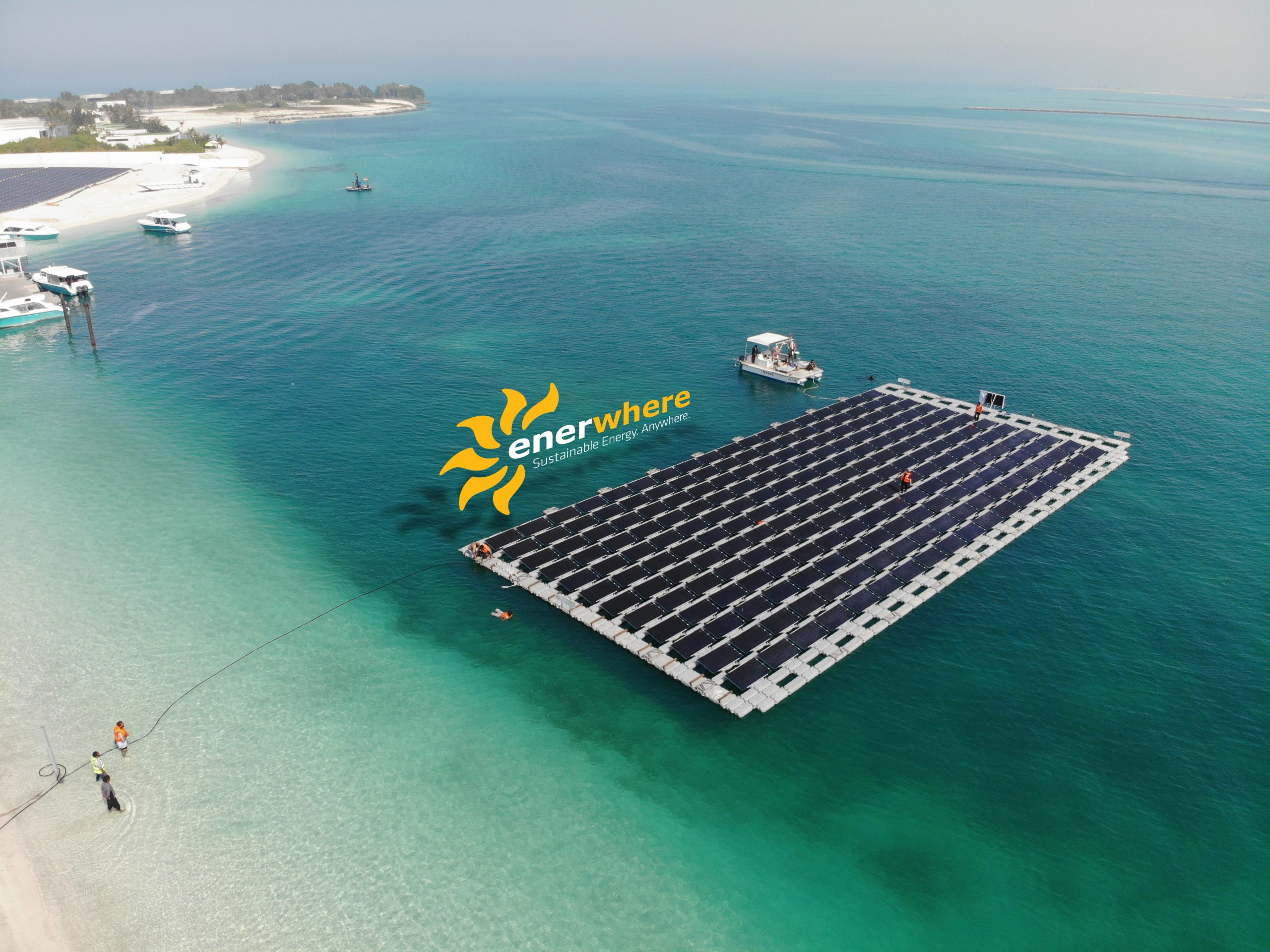
Enerwhere develops distributed renewable and hybrid power systems for commercial, industrial and remote applications in the UAE and the wider region.
Its projects commonly combine solar power, generators and battery storage to reduce fuel consumption and improve operating efficiency.
The company’s approach is particularly relevant to sites that cannot depend entirely on the conventional electricity grid.
Products and services
Enerwhere’s capabilities include:
- Battery-integrated microgrids
- Hybrid solar systems
- Solar-plus-diesel systems
- Remote power
- Temporary energy systems
- Battery storage
- Energy monitoring
- Fuel-consumption reduction
- System operation
- Preventive maintenance
- Commercial energy services
Why choose Enerwhere
Enerwhere is suitable for difficult operating environments where batteries must be coordinated with solar panels, diesel generators and changing site loads.
Its service-based model can be useful for temporary developments and customers who prefer not to own and manage the full energy infrastructure.
Best for
- Construction sites
- Remote facilities
- Industrial operations
- Temporary projects
- Mining support
- Oil and gas facilities
- Hybrid microgrids
- Generator optimisation
Comparison of Leading Battery Storage Providers in the UAE
| Provider | Primary role | Main market | Key strength |
|---|---|---|---|
| Masdar | Project developer and investor | Utility scale | Large renewable and storage infrastructure |
| Emerge | Energy-services provider | Commercial and industrial | Financed turnkey storage and hybrid systems |
| Yellow Door Energy | Distributed-energy developer | Commercial and industrial | Solar-plus-storage service agreements |
| Sungrow | Manufacturer and integrator | Residential to utility scale | Complete BESS and inverter platforms |
| Huawei Digital Power | Technology manufacturer | Residential to utility scale | Integrated batteries, inverters and controls |
| Siemens Energy | Energy-technology integrator | Utility and heavy industry | Grid engineering and lifecycle services |
| Schneider Electric | Electrical and microgrid specialist | Commercial and industrial | Controls, protection and energy management |
| Socomec | Modular BESS provider | Commercial and industrial | Power conversion and modular storage |
| PowernSun | UAE equipment distributor | Residential and commercial | Access to batteries, inverters and accessories |
| Enerwhere | Hybrid-power provider | Remote and industrial sites | Solar, generator and battery microgrids |
The best company depends on whether the customer needs a battery manufacturer, equipment distributor, installation contractor, project developer or long-term energy-services provider.
Types of Battery Storage Systems Available in the UAE
Residential battery storage
Residential batteries store electricity generated by rooftop solar panels or supplied through another permitted source.
A residential system may include:
- Lithium battery modules
- Hybrid inverter
- Battery-management system
- Backup distribution board
- Energy meter
- Monitoring application
- Automatic transfer equipment
- Electrical protection
A home battery may power selected essential circuits rather than the entire property.
Typical protected loads can include:
- Lighting
- Refrigeration
- Internet equipment
- Security systems
- Selected air-conditioning units
- Small appliances
Large equipment such as central air conditioning, electric cookers, pool pumps and water heaters can require substantial battery and inverter capacity.
Commercial and industrial battery storage
Commercial systems are commonly installed to:
- Store solar energy
- Improve resilience
- Reduce generator use
- Manage peak demand
- Support sensitive equipment
- Improve power quality
- Coordinate electric-vehicle charging
- Operate within a microgrid
These installations may use battery cabinets or outdoor containers connected to a dedicated power-conversion system.
Utility-scale battery storage
Utility-scale BESS facilities can store hundreds or thousands of megawatt-hours of electricity.
They may provide:
- Frequency control
- Voltage support
- Operating reserves
- Renewable-energy balancing
- Grid congestion management
- Capacity support
- Energy shifting
- Grid-forming capability
Utility projects require extensive engineering, environmental assessment, grid studies, fire protection and long-term performance modelling.
Solar-plus-storage systems
A solar-plus-storage system combines photovoltaic panels with batteries.
During daylight hours, solar electricity may be used to:
- Supply the customer’s immediate load.
- Charge the battery.
- Export or curtail surplus energy where applicable.
The battery can discharge when solar generation decreases or when additional power is required.
Hybrid generator and battery systems
A hybrid system combines batteries with diesel or gas generators.
The battery may handle:
- Small loads
- Sudden demand changes
- Short interruptions
- Low-load operating periods
- Solar-energy storage
This can allow generators to operate closer to efficient load levels and shut down when they are not required.
Uninterruptible power systems
An uninterruptible power supply provides immediate electricity when the incoming source fails.
It is commonly used for:
- Data centres
- Medical equipment
- Telecommunications
- Security systems
- Industrial controls
- Financial systems
A UPS is not always the same as a general-purpose BESS. UPS systems are commonly designed for immediate, short-duration critical-power support, while energy-storage systems may be optimised for longer operating cycles and energy management.
Containerised battery storage
Containerised systems place battery racks, cooling, controls and safety equipment inside a purpose-designed enclosure.
They are often used for:
- Utility projects
- Factories
- Solar farms
- Remote facilities
- Large commercial sites
- Industrial microgrids
Common Battery Technologies
Lithium iron phosphate
Lithium iron phosphate, commonly abbreviated as LFP, is widely used in stationary energy-storage systems.
Its advantages may include:
- Long cycle life
- Strong thermal stability
- No nickel or cobalt in the cathode
- Suitability for frequent cycling
- Broad availability
System safety still depends on cell quality, battery management, cooling, fire protection and installation.
Nickel manganese cobalt batteries
Nickel manganese cobalt chemistry can provide relatively high energy density.
It has been widely used in electric vehicles and some stationary systems. Selection depends on the required energy density, safety design, cost and expected operating conditions.
Lead-acid batteries
Lead-acid batteries remain available for backup, telecommunications, UPS and smaller off-grid systems.
They may have a lower initial cost but often provide fewer cycles and require more space than modern lithium systems.
Flow batteries
Flow batteries store energy in liquid electrolytes held in external tanks.
Potential advantages include long operating life and the ability to separate power capacity from energy capacity.
They remain less common than lithium-ion systems and are generally considered for specialised or long-duration applications.
Sodium-ion batteries
Sodium-ion technology is emerging as an alternative for stationary storage.
Commercial availability and local support should be carefully verified because the technology is less established than LFP in many markets.
How to Choose a Battery Storage Provider in the UAE
Define the intended application
The first question should be why the battery is needed.
Possible objectives include:
- Backup power
- Solar self-consumption
- Peak-demand management
- Generator reduction
- Off-grid operation
- Grid services
- EV charging support
- Power-quality improvement
- Critical-load protection
A battery designed for occasional backup may not be the best product for daily cycling.
Distinguish power from energy capacity
Battery systems have both a power rating and an energy rating.
Power, measured in kilowatts or megawatts, determines how much electricity the system can deliver at one moment.
Energy capacity, measured in kilowatt-hours or megawatt-hours, determines how long it can supply that power.
For example, a battery may have enough energy to support a building for several hours but lack the inverter power required to start a large motor.
Complete a load assessment
The provider should study:
- Maximum demand
- Average consumption
- Hourly load profile
- Starting currents
- Critical loads
- Solar production
- Generator capacity
- Outage duration
- Future expansion
- EV charging requirements
Avoid accepting a battery recommendation based only on the building’s monthly electricity bill.
Check the operating environment
UAE installations must account for:
- High ambient temperatures
- Direct sunlight
- Dust
- Humidity
- Coastal salt exposure
- Flood risk
- Restricted ventilation
- Limited maintenance access
Outdoor systems should have suitable enclosures, cooling equipment and environmental ratings.
Evaluate battery degradation
Battery capacity gradually declines with age and use.
The provider should explain:
- Expected cycle life
- Calendar life
- Depth of discharge
- State-of-charge limits
- Temperature assumptions
- End-of-life capacity
- Required augmentation
- Warranty throughput limits
Review round-trip efficiency
Round-trip efficiency compares the electricity recovered from the battery with the electricity used to charge it.
Losses occur in:
- Battery cells
- Inverters
- Cables
- Transformers
- Cooling systems
- Auxiliary equipment
Quoted efficiency figures should clearly identify which losses are included.
Examine safety systems
A properly designed BESS may require:
- Battery-management systems
- Temperature monitoring
- Smoke detection
- Gas detection
- Fire detection
- Fire suppression
- Emergency shutdown
- Ventilation
- Thermal barriers
- Electrical isolation
- Remote alarms
- Restricted access
The safety design should comply with applicable UAE requirements and recognised technical standards.
Confirm approvals
Depending on the project, approval may be required from:
- Electricity authorities
- Civil defence
- Municipal authorities
- Free-zone authorities
- Property developers
- Building management
- Environmental authorities
- Electrical consultants
- Insurers
The provider should explain who is responsible for obtaining each approval.
Check cybersecurity
Modern battery systems are often connected to remote monitoring and energy-management platforms.
Ask how the provider protects:
- User accounts
- Remote access
- Control commands
- System data
- Firmware
- Network connections
- Cloud platforms
Cybersecurity is especially important for critical infrastructure and large commercial systems.
Review warranty coverage
The warranty should state:
- Product-warranty period
- Performance guarantee
- Retained capacity
- Cycle limit
- Energy-throughput limit
- Temperature conditions
- Labour coverage
- Travel charges
- Replacement process
- Shipping costs
- Exclusions
A ten-year warranty may contain operating limitations that materially affect coverage.
Assess local after-sales support
Ask whether the provider offers:
- UAE-based technicians
- Remote monitoring
- Emergency response
- Spare battery modules
- Replacement inverters
- Preventive maintenance
- Firmware updates
- Capacity testing
- System augmentation
- Warranty administration
Questions to Ask a Battery Storage Provider
Before appointing a provider, ask:
- What application is the proposed system designed for?
- What is its power rating?
- What is its usable energy capacity?
- Which battery chemistry is used?
- What depth of discharge is permitted?
- What cycle life is expected?
- What capacity remains at the end of the warranty?
- Which inverter or power-conversion system is included?
- Can it operate during a grid outage?
- Which loads will it support?
- How long will backup power last?
- Is solar integration included?
- Can it work with an existing generator?
- What cooling system is used?
- Which fire-protection systems are included?
- Which UAE approvals are required?
- Who obtains those approvals?
- Is remote monitoring included?
- Where is system data stored?
- What maintenance is required?
- Are replacement parts stocked in the UAE?
- What is the emergency response time?
- Is installation included?
- What is excluded from the quotation?
- How will batteries be recycled or disposed of?
Frequently Asked Questions
What is a battery energy-storage system?
A battery energy-storage system stores electrical energy and releases it when required.
It includes battery cells, battery-management equipment, power-conversion systems, controls, cooling, electrical protection and safety systems.
Can a battery power an entire villa?
Yes, but the required capacity may be substantial, especially when air conditioning, cooking equipment, pumps and water heating are included.
Many residential systems are designed to power selected essential loads instead.
Can batteries be added to an existing solar system?
In many cases, yes.
The installer must assess the existing inverter, electrical design, metering arrangement, approvals and available installation space.
An alternating-current-coupled battery may be suitable when replacing the existing solar inverter is undesirable.
How long will a battery provide backup power?
Backup duration depends on:
- Usable battery capacity
- Connected load
- Inverter efficiency
- Battery condition
- Temperature
- Reserve settings
A qualified provider should prepare a load schedule showing estimated operating time.
Can a battery replace a generator?
It can replace or reduce generator use in some applications.
For long outages or very large loads, a hybrid battery-and-generator system may be more practical than battery storage alone.
Do batteries work in UAE heat?
Battery systems can operate in the UAE when they are appropriately designed, cooled and installed.
High temperatures can accelerate degradation, so thermal management is essential.
Are outdoor battery systems safe?
Properly engineered outdoor systems can be safe when they include suitable enclosures, cooling, monitoring, electrical protection and fire-safety measures.
Installation should follow manufacturer instructions and applicable local requirements.
What is battery cycling?
One cycle represents charging and discharging energy through the battery.
A full cycle can occur as one complete discharge or as several partial discharges adding up to the equivalent amount.
What is depth of discharge?
Depth of discharge describes the proportion of battery capacity used before recharging.
Using a smaller portion of total capacity can sometimes extend battery life, depending on the chemistry and operating conditions.
What does state of charge mean?
State of charge indicates how much usable energy remains in the battery at a particular time.
It is similar to the fuel gauge in a vehicle.
What is battery augmentation?
Augmentation involves adding battery capacity during the project’s operating life to compensate for degradation or increased demand.
It is common in large storage projects with long-term capacity commitments.
Can battery storage reduce electricity costs?
It may reduce costs where the tariff structure, solar generation, demand profile and operating rules create a financial benefit.
Savings should be supported by a detailed financial model rather than a general estimate.
Do battery systems require maintenance?
Yes.
Maintenance may include:
- Software updates
- Cooling-system checks
- Electrical inspections
- Alarm testing
- Capacity testing
- Fire-system inspection
- Cleaning
- Connection tightening
- Battery-health analysis
How long do BESS batteries last?
Service life depends on chemistry, temperature, cycling, charging rate, depth of discharge and maintenance.
Residential and commercial products commonly carry warranties based on years, retained capacity, cycle count or total energy throughput.
What happens to batteries at the end of their life?
Batteries should be collected, transported and processed through authorised waste-management or recycling channels.
The procurement contract should identify who is responsible for removal and disposal.
Conclusion
The best battery storage providers in the UAE serve distinctly different parts of the market.
Masdar is the leading UAE developer for utility-scale storage and major renewable-energy infrastructure. Emerge and Yellow Door Energy are strong options for commercial and industrial customers seeking financed, turnkey solar-and-storage systems.
Sungrow and Huawei Digital Power provide integrated battery, inverter and control technologies across residential, commercial and utility applications. Siemens Energy is particularly relevant to grid, power-plant and heavy-industrial projects requiring extensive engineering and lifecycle services.
Schneider Electric and Socomec support commercial microgrids, electrical integration and energy-management applications. PowernSun provides access to battery and inverter equipment through a UAE distribution model, while Enerwhere specialises in hybrid power systems for remote, industrial and temporary sites.
Before selecting a provider, customers should define the intended application, complete a detailed load assessment and compare usable capacity, system power, battery chemistry, degradation, cooling, fire protection, warranty coverage and local technical support.
Battery storage is not a standard product that should be selected based on price alone. A reliable system must be correctly sized, safely integrated and supported throughout its operating life.
Read Also: 10 Best Wind Energy Companies in the UAE