
Nyongesa Sande
No Result
View All Result
  • News
    • World
    • Africa
  • Politics
  • Business
  • Tech
  • AI
  • Telecom
  • Sports
  • Opinion
  • Lifestyle
  • Live
Nyongesa Sande
  • About Us
    • Nyosake Designers
      • Nyosake Webmasters
      • Nyosake Investment
  • Contact Us
    • Newsroom Contact
  • Ownership Disclosure
  • Advertise
No Result
View All Result
Nyongesa Sande
No Result
View All Result
  • News
  • Politics
  • Business
  • Tech
  • AI
  • Telecom
  • Sports
  • Opinion
  • Lifestyle
  • Live
ADVERTISEMENT

Home » Australian Dollar (AUD): Overview, History, and Significance

Australian Dollar (AUD): Overview, History, and Significance

NyongesaSande News Desk by NyongesaSande News Desk
7 months ago
in Money
Reading Time: 4 mins read
A A
Australian Dollar (AUD): Overview, History, and Significance

The Australian dollar (AUD) is the official currency of Australia, along with its external territories and three sovereign Pacific Island states: Kiribati, Nauru, and Tuvalu. Known symbolically as $ or A$, the Australian dollar is widely recognized as one of the most traded and held reserve currencies in the world. As of 2024, it is the sixth most-traded currency globally, with a significant role in the international foreign exchange market.

  • History of the Australian Dollar
    • Introduction and Decimalisation
  • Key Features of the Australian Dollar
    • Coins
    • Banknotes
    • Currency Symbols and Use
    • Exchange Rate and Global Standing
  • Conclusion

History of the Australian Dollar

Introduction and Decimalisation

The Australian dollar was introduced on 14 February 1966 following the decimalisation of the currency system, replacing the non-decimal Australian pound at a rate of A$2 = £A1. The decision was made after years of deliberation regarding the need for a unified and decimal-based currency. Prior to the adoption of the dollar, the Australian pound had been in circulation since 1910, pegged initially to the British pound.

The introduction of the AUD was part of the global trend towards decimalisation, with Australia opting for a new currency unit, the dollar, modeled after South Africa’s shift to the rand. This change was marked by public consultations, and after some initial resistance, the currency was named the “dollar” over the initial suggestion of the “royal.”

ADVERTISEMENT

Key Features of the Australian Dollar

Coins

The first set of Australian dollar coins was introduced in 1966 in denominations of 1 and 2 cents, followed by 5, 10, 20, and 50 cents in cupronickel. In 1984, the $1 coin was introduced, and in 1988, the $2 coin replaced the higher denomination paper note. The 1 and 2 cent coins were discontinued in 1991, and the current denominations in circulation include:

  • 5c, 10c, 20c, 50c coins
  • $1, $2 coins

The Australian 50-cent coin is notably large in size compared to most other global coins.

ADVERTISEMENT

Banknotes

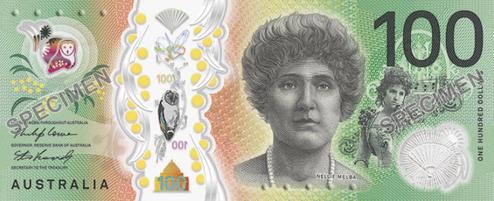
Australia introduced the first polymer banknotes in 1988, marking a revolutionary step in currency production. The $10 polymer note was released to commemorate the bicentenary of European settlement in Australia, followed by $5, $20, $50, and $100 polymer notes in subsequent years. The polymer notes are more durable and cleaner than traditional paper notes and are produced by Note Printing Australia.

Notable features of the current polymer series include:

  • $5 featuring Queen Elizabeth II and Parliament House
  • $10 with Banjo Paterson and Dame Mary Gilmore
  • $50 featuring David Unaipon and Edith Cowan
  • $100 with Dame Nellie Melba and General Sir John Monash

These notes include advanced security features and tactile elements, such as Braille for accessibility.

ADVERTISEMENT

Currency Symbols and Use

The AUD is often symbolized as $ or A$, with the latter used to distinguish it from other dollar-denominated currencies. It is subdivided into 100 cents, with coin denominations ranging from 5c to $2 and banknotes from $5 to $100.

Exchange Rate and Global Standing

The Australian dollar has fluctuated in value since its introduction, particularly after the 1971 collapse of the Bretton Woods system, which led to the adoption of floating exchange rates. The AUD has seen highs and lows, reaching parity with the US dollar at various times in the 2010s, but also experiencing declines due to global economic events.

The Australian dollar is influenced heavily by commodity prices, as Australia’s economy is resource-rich, with significant exports in minerals, energy, and agricultural products. This makes the AUD sensitive to changes in global commodity markets, particularly in Asia.

Conclusion

The Australian dollar (AUD) has become a cornerstone of the Australian economy and holds a significant position in global finance. From its introduction in 1966 to its current status as a top-traded currency, the AUD has adapted to changing economic landscapes, cementing its place as an important player in both domestic and international markets.

Tags: AUDAustralia economyAustralian dollarbanknotescoinscurrencyHistoryReserve Bank of Australia
Google Add as a Preferred Source on Google
Previous Post

Honorifics for the Dead in Judaism

Next Post

“Dance (Ass)” by Big Sean featuring Nicki Minaj: Song Overview, Reception, and Success

NyongesaSande News Desk

NyongesaSande News Desk

Nyongesa Sande offers diverse content across news, technology, entertainment, and more, aiming to provide readers with a wide range of informative and engaging articles. NYONGESA SANDE's dedicated team provides our audience not only with the highly relevant news but also with outstanding interactive experience.

Related Posts

Rolled euro banknotes and stacked coins on a table representing savings, investments, and financial growth.
Money

Most Traded Currencies in Forex Explained

5 days ago
Kenyans Transacted KES 41.7 Trillion Through M-PESA
Money

Kenyans Transacted KES 41.7 Trillion Through M-PESA

1 month ago
Airtel Money IPO Delayed Amid Market Uncertainty
Money

Airtel Money IPO Delayed Amid Market Uncertainty

1 month ago
List of Kenya Saccos Paybill Numbers
Money

Kenya Water Companies PayBill Numbers List

5 months ago
Top International Money Transfer Platforms in Kenya
Finance

Top International Money Transfer Platforms in Kenya

5 months ago
Uganda Shilling Ranked World’s Most Stable Currency – Ggoobi
Money

Uganda Shilling Ranked World’s Most Stable Currency – Ggoobi

5 months ago
Load More
Next Post
“Dance (Ass)” by Big Sean featuring Nicki Minaj: Song Overview, Reception, and Success

"Dance (Ass)" by Big Sean featuring Nicki Minaj: Song Overview, Reception, and Success

A$$hole: How I Got Rich and Happy by Not Giving a Shit About You by Martin Kihn: Overview and Reception

A$$hole: How I Got Rich and Happy by Not Giving a Shit About You by Martin Kihn: Overview and Reception

ADVERTISEMENT

Who We Are

Nyongesa Sande

NyongesaSande.com is a digital news and media platform covering breaking news, business, technology, AI, politics, sports, world affairs and African innovation.

News Sections

  • News
    • World
    • Africa
  • Politics
  • Business
  • Tech
  • AI
  • Telecom
  • Sports
  • Opinion
  • Lifestyle
  • Live

Editorial Standards

  • Editorial Policy
  • Fact Checking Policy
  • Corrections Policy
  • Ethics Policy
  • AI Usage Policy
  • News Tips
  • Submit Press Release

Legal

  • Privacy Policy
  • Terms of Use
  • Cookie Policy
  • Disclaimer
  • Risk Disclaimer
  • DMCA
  • Ad Choices

Our Company

  • About Us
    • Nyosake Designers
      • Nyosake Webmasters
      • Nyosake Investment
  • Contact Us
    • Newsroom Contact
  • Ownership Disclosure
  • Advertise
  • Privacy Policy
  • Terms of Use
  • Cookie Policy
  • Disclaimer
  • Risk Disclaimer
  • DMCA
  • Ad Choices

NyongesaSande.com is an independent digital news and media platform covering Africa, business, technology, AI, politics and global developments.

© 2026 NyongesaSande.com. All rights reserved.

No Result
View All Result
  • News
    • World
    • Africa
  • Politics
  • Business
  • Tech
  • AI
  • Telecom
  • Sports
  • Opinion
  • Lifestyle
  • Live

NyongesaSande.com is an independent digital news and media platform covering Africa, business, technology, AI, politics and global developments.

© 2026 NyongesaSande.com. All rights reserved.